Suyamoon Pathak

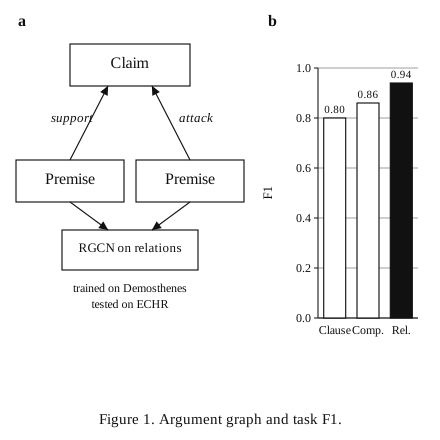
Figure 1. Argument graph and task F1.

Legal argumentation mining

M.Tech thesis with Dr. Ashutosh Modi, under review. The models are BERT, LegalBERT, RoBERTa, InCaseLawBERT, and an RGCN, with zero- and few-shot prompts from Gemini-2.5-Flash, Llama3-8b, and Gemma3-27b.

Clause F1 is 0.80, component F1 is 0.86, and relation F1 is 0.94. Models trained on the Demosthenes set were also tested on the European Court of Human Rights corpus.
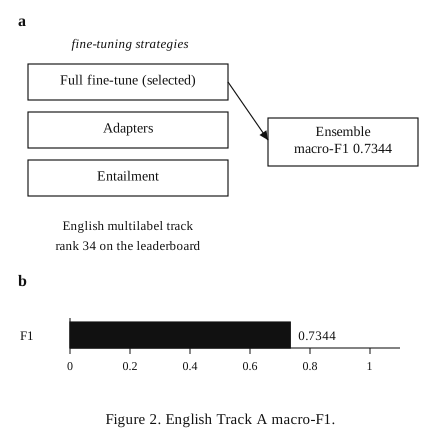
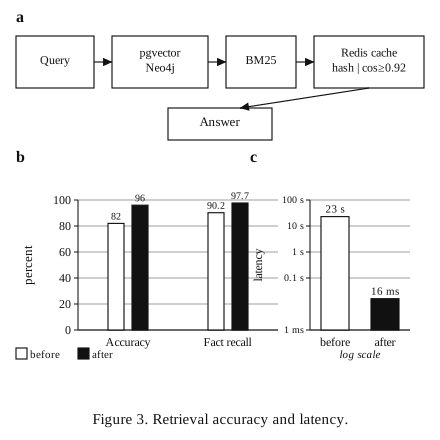
Figure 2. English Track A macro-F1.

Text-based emotion detection

SemEval-2025 Task 11, Track A, on English multilabel emotion classification, published in the ACL Anthology. The submitted system is an ensemble of fully fine-tuned transformers. Adapters and an entailment setup were trained as well.

Test Macro-F1 is 0.7344. The entry placed 34th on the English Track A leaderboard.

Figure 3. Retrieval accuracy and latency.

Hybrid retrieval at Cortekz

Built at Cortekz from January to September 2026. Hybrid retrieval on LightRAG, with Neo4j, PostgreSQL/pgvector, and a BM25 reranker, moved benchmark accuracy from 82% to 96% and fact recall from 90.2% to 97.7%.

A two-tier Redis cache, exact hash plus cosine at least 0.92, cut repeat queries from about 23 seconds to about 16 milliseconds. The code is private.

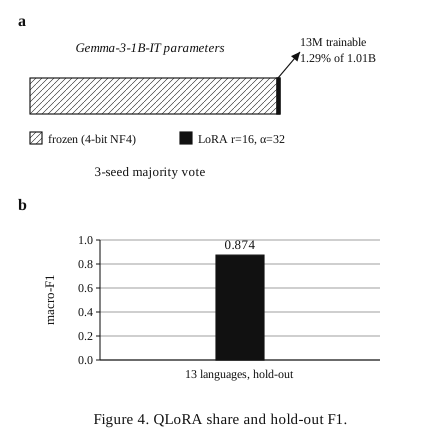
Figure 4. QLoRA share and hold-out F1.

Multilingual sentiment classification

Sentiment labels for 13 Indian languages and more than eight scripts, including Devanagari, Bengali, Gurmukhi, Tamil, Telugu, and Perso-Arabic. Gemma-3-1B-IT was fine-tuned with QLoRA in 4-bit NF4, updating 13M of 1.01B parameters, which is 1.29%.

A three-seed majority vote reached 0.874 macro-F1 on a dual-stratified hold-out. Some languages had about 70 training examples.

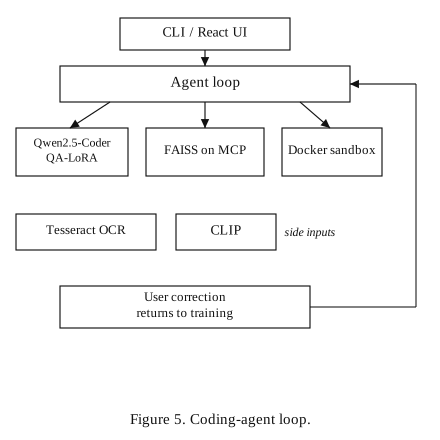
Figure 5. Coding-agent loop.

Autonomous coding agent

The agent handles completion, debugging, refactoring, documentation, and unit tests. Qwen2.5-Coder models were fine-tuned with QA-LoRA. Inference and FAISS retrieval run on MCP servers, and user code runs in Docker.

Tesseract reads error screenshots and CLIP reads diagrams. Corrections from the CLI or the React and Flask/FastAPI interface go back into training.

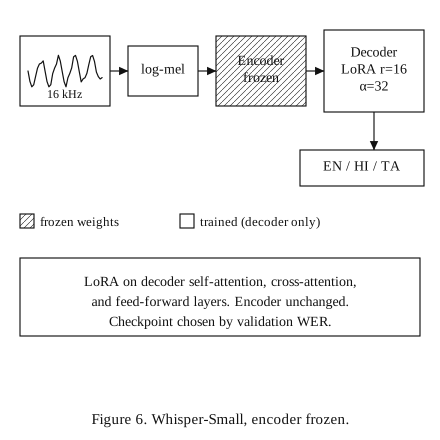
Figure 6. Whisper-Small, encoder frozen.

Whisper-Small speech recognition

LoRA fine-tune of Whisper-Small (244M parameters) for code-mixed English, Hindi, and Tamil, on a 16 GB T4. The encoder stays frozen. LoRA with rank 16 and alpha 32 is applied to the decoder’s self-attention, cross-attention, and feed-forward layers.

Training used FP16, gradient checkpointing, and SpecAugment. The kept checkpoint is the one with the best validation WER.

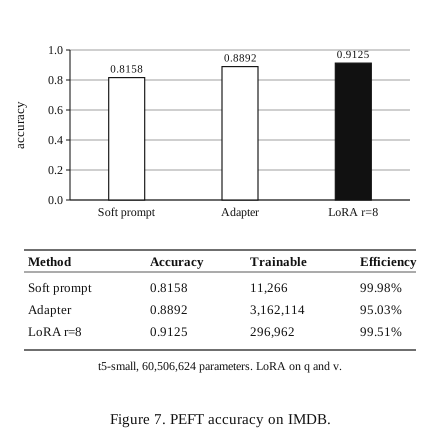
Figure 7. PEFT accuracy on IMDB.

PEFT methods on T5

Course project for CS781. Soft prompts, Houlsby adapters, and LoRA were compared on t5-small for IMDB sentiment. Soft prompts trained 11,266 embeddings out of 60,506,624 parameters. Adapters used the Houlsby configuration, 3,162,114 trainable parameters.

Test accuracy was 0.9125 for LoRA (rank 8 on the query and value projections, 296,962 trainable parameters), 0.8892 for adapters, and 0.8158 for soft prompts.

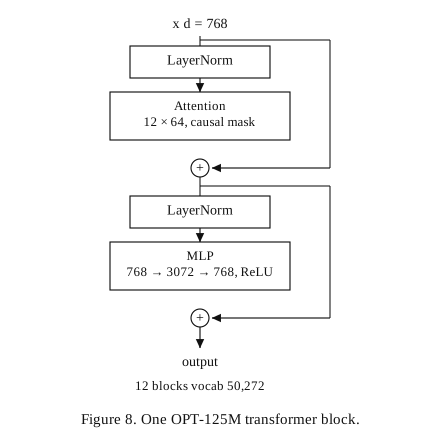
Figure 8. One OPT-125M transformer block.

Mechanistic interpretability of OPT-125M

Course project for CS781. The forward pass of facebook/opt-125m was reconstructed in TransformerLens and checked against HookPoint caches at seven points in the first block.

The network has 12 layers, d_model 768, 12 heads of size 64, an MLP width of 3072, and a vocabulary of 50,272.

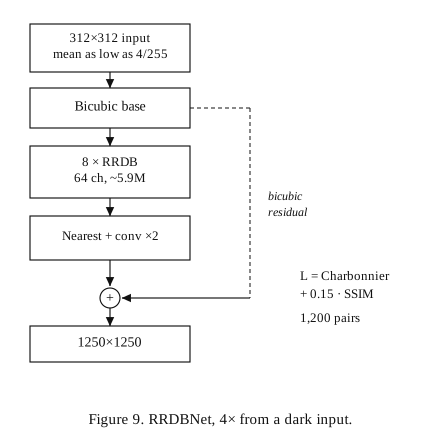
Figure 9. RRDBNet, 4× from a dark input.

Low-light restoration and super-resolution

One network maps 312×312 inputs, 4× downscaled and very dark (mean brightness as low as 4/255), to 1250×1250 images. The model is an RRDBNet of about 5.9M parameters: eight residual-in-residual dense blocks at 64 channels, and nearest-neighbor plus convolution for the upsample.

Training starts from a bicubic residual. The loss is Charbonnier plus 0.15 times SSIM, on 1,200 aligned pairs.

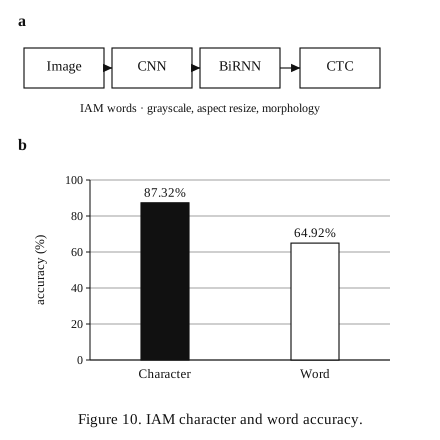
Figure 10. IAM character and word accuracy.

AksharDrishti

Course project for CS685. A CRNN with CTC decoding reads IAM word images after grayscale conversion, an aspect-preserving resize, and morphological cleanup, including a Gaussian blur and a threshold.

Character accuracy is 87.32%. Word accuracy is 64.92%.

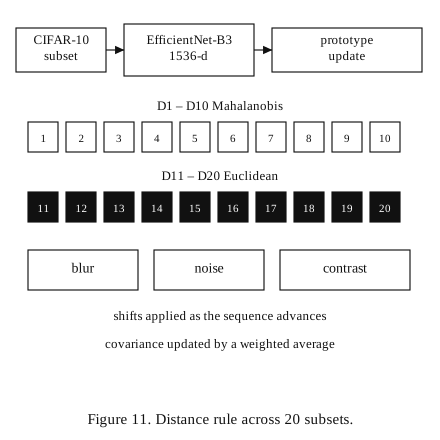
Figure 11. Distance rule across 20 subsets.

Adaptive prototype learning

Course project for CS771. A prototype classifier follows 20 sequential CIFAR-10 subsets. Features are 1536-dimensional vectors from EfficientNet-B3.

Distance is Mahalanobis on subsets 1–10 and Euclidean on subsets 11–20. The subsets add blur, noise, and contrast changes. Prototypes and covariances are updated with a weighted average.

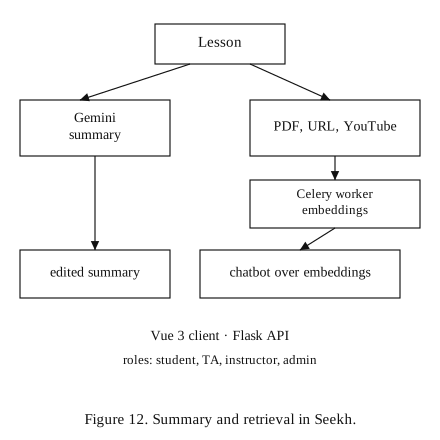
Figure 12. Summary and retrieval in Seekh.

Seekh 2.0

A learning management system with roles for students, teaching assistants, instructors, and admins. Gemini writes a summary of each lecture, and the summary can be edited by hand.

A chatbot answers from embeddings of PDFs, URLs, and YouTube videos. A Celery worker builds those embeddings. The client is Vue 3 and the API is Flask.

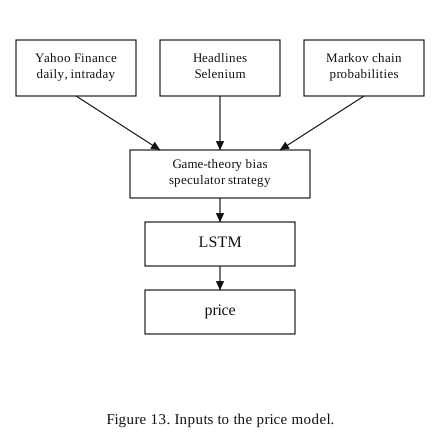
Figure 13. Inputs to the price model.

StockSage

A price model that combines an LSTM with game-theoretic biases and sentiment on news headlines. Daily and intraday closes come from the Yahoo Finance API. Headlines were collected with Selenium.

Markov chains estimate the probabilities used to set the speculator’s strategy inside that game.

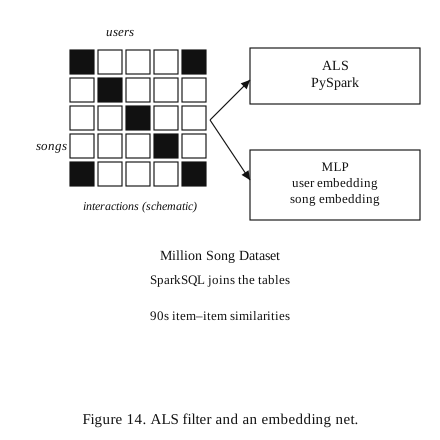
Figure 14. ALS filter and an embedding net.

Timeless Tunes

Song recommendations on the Million Song Dataset, with a 90s item-similarity view. ALS in PySpark fits a collaborative filter. A TensorFlow network with a user embedding and a song embedding scores interactions.

SparkSQL builds the joined tables the two models read.

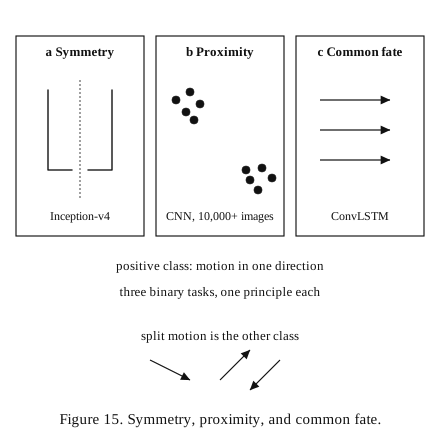
Figure 15. Symmetry, proximity, and common fate.

Gestalt principles in CNNs

Course project for CS786. Three experiments test whether a network picks up symmetry, proximity, and common fate. Symmetry fine-tunes Inception-v4. Proximity trains a CNN from scratch on more than 10,000 synthetic images.

Common fate uses a ConvLSTM on clips of objects that move together or do not.

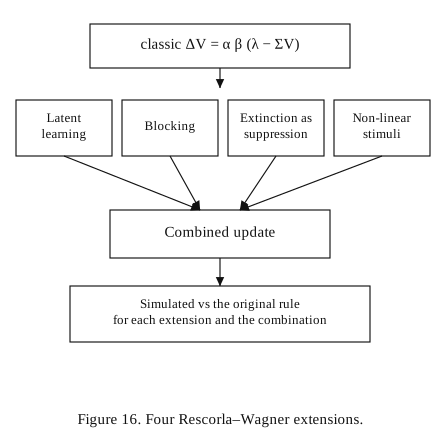
Figure 16. Four Rescorla–Wagner extensions.

Enhanced Rescorla–Wagner model

Course project for CS786. Four extensions of the classic update cover latent learning, blocking, extinction treated as suppression so that spontaneous recovery can occur, and non-linear stimulus combinations.

Those four pieces are also written as one combined update. Each variant was simulated against the original rule.

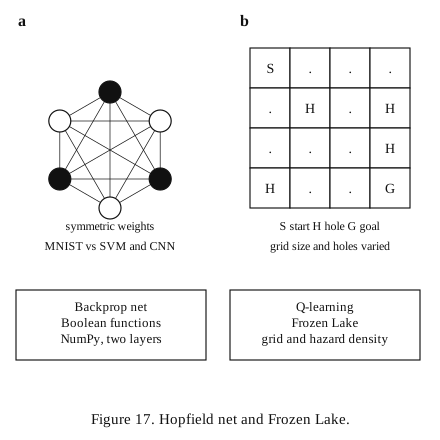
Figure 17. Hopfield net and Frozen Lake.

Hopfield networks and reinforcement learning

Course project for CS786. A two-layer network in NumPy learns Boolean functions by backpropagation. A Hopfield classifier on MNIST is compared with an SVM and a CNN.

A Q-learning agent is trained on Frozen Lake. Grid size and the number of holes are varied when reading the learning curves.

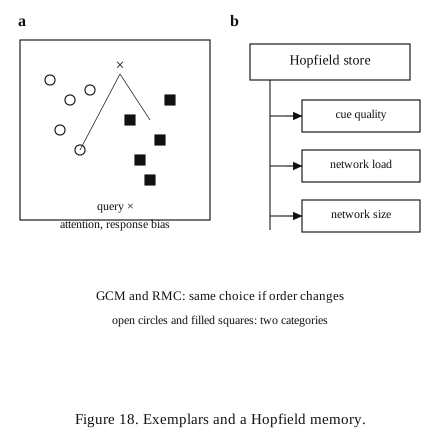
Figure 18. Exemplars and a Hopfield memory.

Categorization and associative memory

Course project for CS786. A Generalized Context Model and Anderson’s Rational Model of Categorization predict choices, with attention weights and a response bias. Both models give the same predictions when the order of examples changes.

A Hopfield network stores patterns. Recall is measured against cue informativeness, how many patterns are stored, and the size of the net.

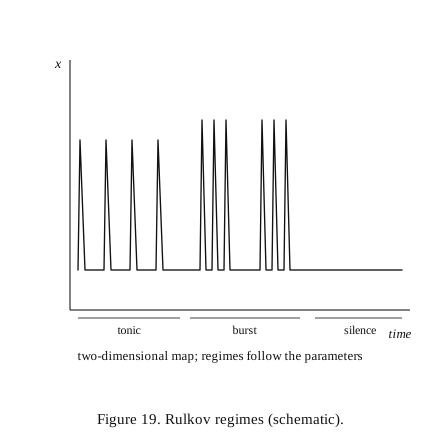
Figure 19. Rulkov regimes (schematic).

Rulkov map neural dynamics

Course project for CS786. The Rulkov map, a two-dimensional model of a neuron, is simulated while its parameters change.

The runs reproduce tonic spiking, bursting, and stretches of silence.

Figure 20. From a sensor to a diagnosis.

AI-enabled IoMT for diagnosis

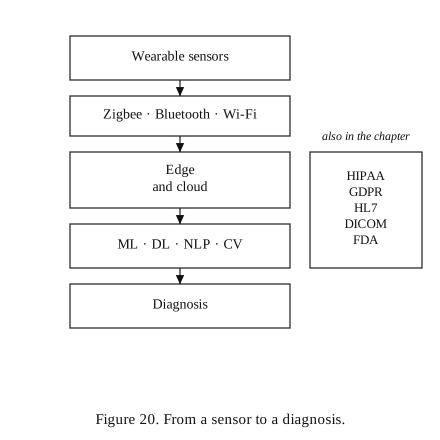
Chapter 7 of Health 5.0, Taylor & Francis, with Hiren Kumar Thakkar and Ketan Sabale. The chapter reviews machine learning, deep learning, NLP, and computer vision for imaging and clinical text.

It also describes sensors, Zigbee, Bluetooth, Wi-Fi, and the split between edge and cloud processing, along with HIPAA, GDPR, HL7, DICOM, and FDA constraints.

Figure 21. Full commits, log scale.

ext4 / JBD2 fast commits

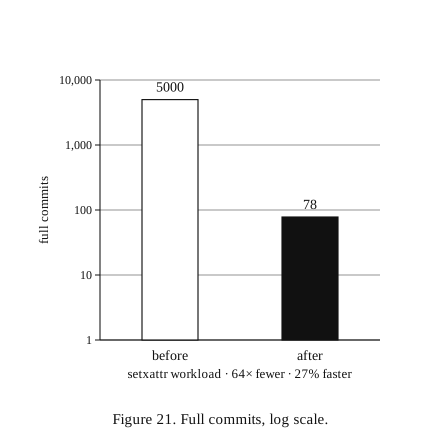
Course project for CS614. Two patches to Linux 6.1.4 add fast-commit support for inline extended attributes and for fallocate COLLAPSE_RANGE and INSERT_RANGE.

On the extended-attribute workload, full journal commits fell from 5000 to 78, with a 27% wall-time speedup. Crash-recovery tests and an xfstests subset reported no regressions.

Figure 22. Nine years of tourism tables.

Indian tourism data

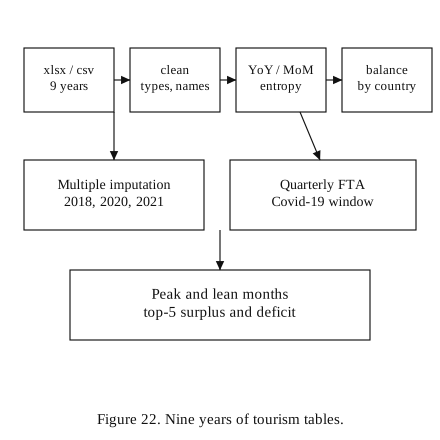
Course project for CS685. Nine years of Indian tourism spreadsheets are cleaned, then scored for year-over-year and month-over-month change, peak and lean months, and tourist balance by country and continent.

Missing years, including 2018, 2020, and 2021, are filled by multiple imputation. Quarterly foreign-tourist arrivals cover the Covid-19 period.

Figure 23. Weather observations and bird tracks.

Climate data visualization

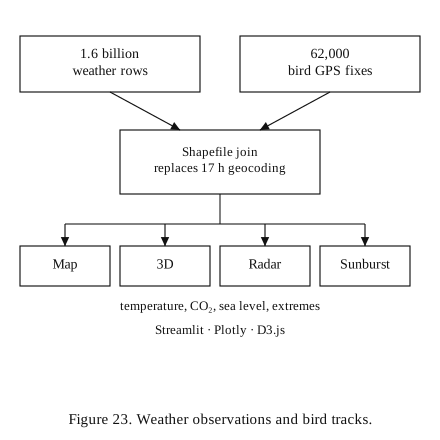
Course project for CS661. Pipelines cover 1.6 billion weather observations and 62,000 bird GPS records, then temperature, CO₂, sea level, extremes, and migration.

A shapefile join replaced a reverse-geocoding step that had taken 17 hours. The views are Streamlit, Plotly, and D3.js.

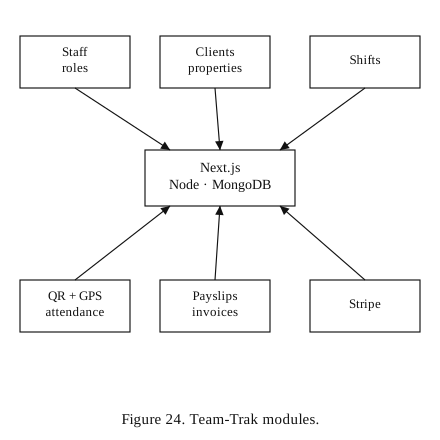
Figure 24. Team-Trak modules.

Team-Trak

A web application for cleaning companies to track staff, clients, properties, and shifts, written in Next.js, Node.js, and MongoDB. Attendance is a QR code checked against GPS.

Payslips and invoices are generated from recorded hours. Stripe takes the subscription payments, and Google Maps fills in addresses.

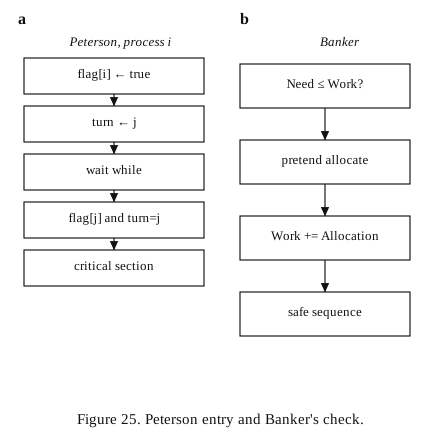
Figure 25. Peterson entry and Banker's check.

SahaChakra

Pages for process synchronization and deadlock avoidance, in HTML, CSS, and JavaScript. The set includes Banker’s algorithm, Peterson’s algorithm, a turn variable, a lock variable, and test-and-set.

Binary and counting semaphores and the producer-consumer problem are on the same site. The page redraws state as each algorithm steps.

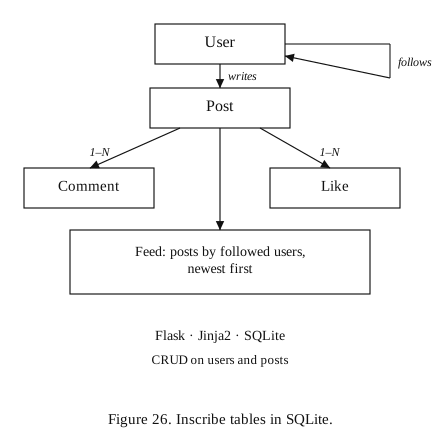
Figure 26. Inscribe tables in SQLite.

Inscribe

A multi-user blog built with Flask, Jinja2, and SQLite. Accounts follow one another, and the home feed lists posts from followed accounts in time order.

Posts can be created, edited, and deleted. Likes and comments sit on each post.